Ketone esters potently and rapidly increase ketone levels in the blood
Explore how ketone esters provide fast brain fuel, support memory and focus, and what research shows for Alzheimer’s, mild cognitive impairment, and cognition
All cells need fuel to operate. And glucose is the main fuel for people who eat a typical high-carbohydrate diet. Insulin allows glucose to enter cells. But in type 2 diabetes and prediabetes, the cells don’t respond normally to insulin to let glucose in–this is called insulin resistance. Alzheimer’s and many other brain disorders have features of type 2 diabetes. Therefore, some areas of the brain don’t use glucose effectively. Ketones are an alternative fuel to glucose. Ketone esters are supplements that can rapidly increase ketone levels to energize the brain and other organs affected by insulin resistance. Many studies of ketones for mild cognitive impairment, Alzheimer’s, and cognitive decline are published or in progress.
People with diabetes have a 30% risk of developing Alzheimer’s or other type of dementia along with many other complications affecting vision, circulation, the heart, and kidneys. Insulin resistance is a key feature of type 2 diabetes, prediabetes, and metabolic syndrome.
About 15 % of US adults have diabetes but the risk increases with age. About 29% of US adults aged 65 and over have diabetes and nearly 40% have prediabetes, which progresses to diabetes within 5 years on average.
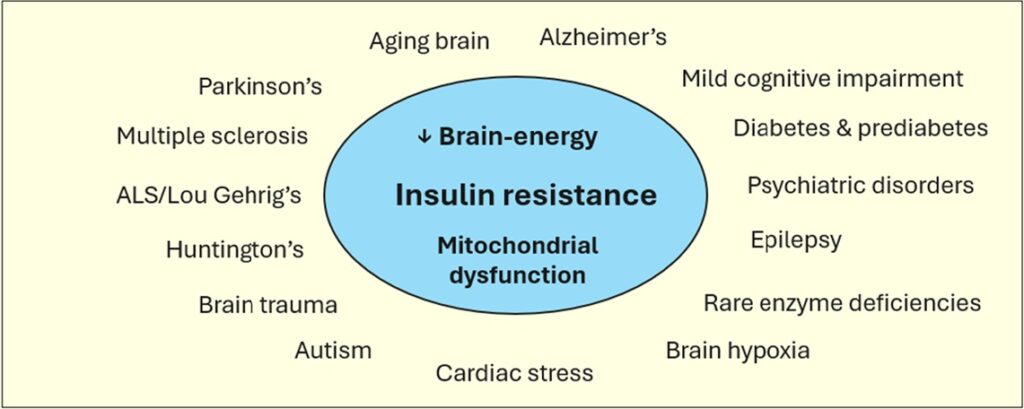
Disorders with insulin resistance, decreased brain energy, and mitochondrial dysfunction
Skip down to ketone ester products
Looking for an easy food-based approach? See Coconut Oil & MCT Oil for Brain Health
Ketones can bypass insulin resistance
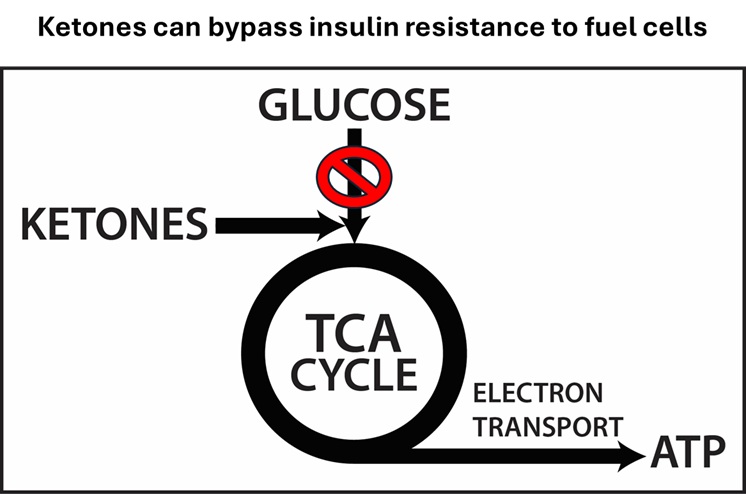 Ketones are an alternative fuel to glucose that are naturally produced from body fat during fasting. Unlike glucose, ketones don’t require insulin to enter tissues and cells, including the brain and brain cells. Ketones enter the same pathway as glucose to make the energy molecule ATP. During a prolonged fast or starvation, ketones can provide up to 2/3 of the fuel the brain needs to survive.
Ketone esters could supply the brain with energy in people with Alzheimer’s and mild cognitive impairment.
Blood levels of ketones also increase when eating coconut and MCT oil and also, when one eats a high-fat low carbohydrate diet–a “ketogenic diet”. Children and adults with epilepsy have used the ketogenic diet for more than a century to eliminate or reduce seizures.
More recently, many people with type 2 diabetes use a ketogenic diet to successfully control blood glucose and go into remission. And they can often reduce or even eliminate their need for medications with physician supervision. As long as one stays on a low-carb diet, it is possible for someone with type 2 diabetes or prediabetes to get their blood glucose back into the normal range. And keep it there.
Ketones also reduce inflammation
Inflammation is always present in the brains of people with Alzheimer’s. And inflammation is common as part of the aging process and in many other health issues. Some triggers of inflammation include chronically elevated blood glucose, infections, injuries, a poor diet, smoking, drinking too much alcohol, chronic stress, and air pollution. Eating foods with refined flour, added sugar, and processed meats can promote chronic inflammation. High-fructose corn syrup is highly inflammatory and is present in many sweetened beverages and ultra-processed foods.
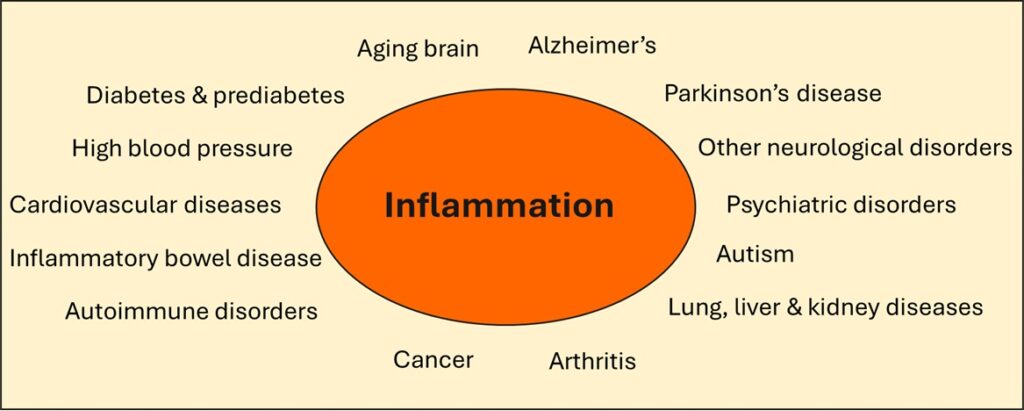
Inflammation is a key feature in Alzheimer’s and many other health conditions.
Besides providing fuel to cells, ketones can tamp down inflammation in several ways–for example, by reducing the production of damaging substances and by removing these substances. Making lifestyle changes and taking a ketone ester could help get inflammation under control in people with Alzheimer’s or other cognitive impairment, which could lead to healthier aging.
Ketone esters are an easy way to increase blood ketone levels
Ketone ester drinks are available to the public as a supplement. These drinks contain natural ketones that can rapidly increase ketone levels 5 to 10 times higher than coconut or MCT oil. No special diet is needed!
Many athletes use ketone esters to improve their performance and recovery. But now, ketones esters are a growing area of research for treatment and prevention of Alzheimer’s, and many other disorders. About 2/3 of people who take ketone esters are athletes. But many other people taking ketone esters have Alzheimer’s or other cognitive impairment or neurological disorder.
There are more than 90 studies completed or currently in progress of the ketone ester for Alzheimer’s, mild cognitive impairment, Parkinson’s, and for a variety of other medical conditions. These include diabetes, metabolic syndrome, neurological and psychiatric disorders, and cancers. To date, most of the completed studies of the ketone ester have been in athletes. So, caution is advised for anyone who plans to use ketone esters for any purpose other than athletic performance.
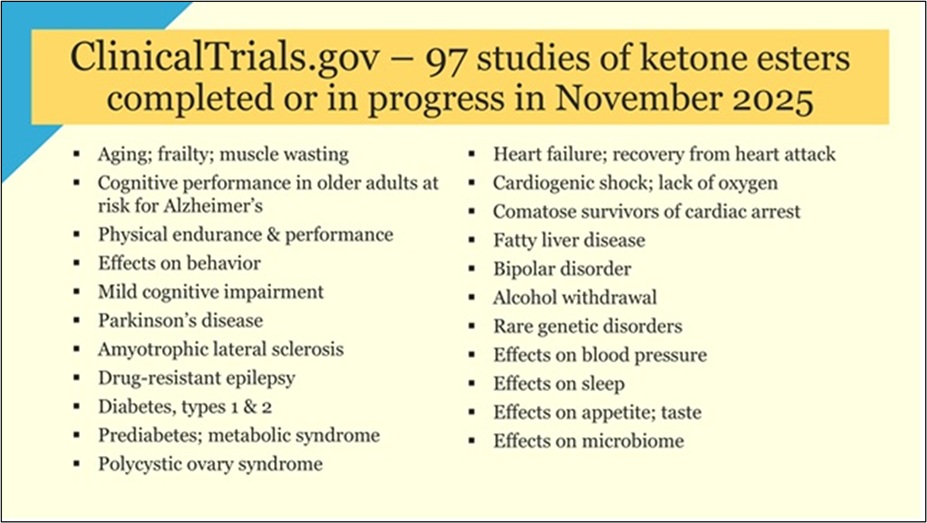
How ketones work in the brain
In Alzheimer’s disease, some other types of dementia, and Parkinson’s disease, certain parts of the brain don’t take up glucose normally. Insulin resistance is a major part of the problem. And this problem may start 10 or 20 years before symptoms appear.
Abnormal glucose uptake in the brain is also a problem in epilepsy, autism, other neurodegenerative disorders, and psychiatric conditions like schizophrenia, bipolar disorder, and major depression. Inflammation is also a key factor in the same disorders.
Ketones provide fuel directly and immediately to starved cells in the brain and reduce inflammation. Therefore, increasing blood ketone levels through with a high-fat low-carb diet, eating coconut or MCT oil, or by taking exogenous ketone supplements could potentially treat or even prevent Alzheimer’s.
What is a ketone ester?
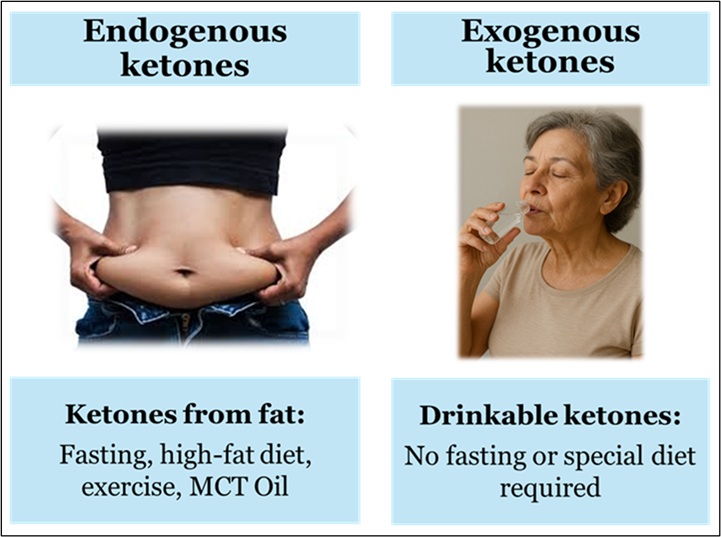 A ketone ester contains ketones that are identical to those that your body makes naturally when you use fat as fuel during fasting. But ketones also result from eating a low-carb diet, coconut oil, or MCT oil, and during moderate exercise. These are called “endogenous” ketones—made within the body.
Ketone esters (and ketone salts) are sometimes referred to “exogenous ketones”. These are ketones taken as a supplement or drink without your body having to make them. So, your body can make ketones, but you can also get ketones in a supplement.
The major advantage to taking a ketone ester is that the ketone level increases rapidly–within 30 minutes. This is important because studies show that higher ketone levels in the blood correlate with higher ketone levels in the brain.
A drawback for most ketone esters is the taste, which has improved over time but still needs work.
Prefer a softer approach? Ketone Salts for Brain Health & Fitness
Ketone ester vs. MCT oil
MCT oil is also a type of endogenous ketone supplement since the MCTs are converted to ketones after eating. And the ketone ester can raise ketone levels in the blood 5 to 10 times higher than MCT or coconut oils. On the other hand, taking coconut oil and/or MCT oil can provide a sustained level of ketones when consumed several times daily. Taking a ketone ester can boost the ketone levels higher for several hours.
Taking coconut and/or MCT oil together with the ketone ester, if tolerated, could help sustain higher ketone levels longer.
Learn more Coconut and MCT oil for sustained mild ketosis
 The Power of Ketones
People often ask me if it is worth trying ketone salts and ketone esters in the latest stages of Alzheimer’s and other dementias. This 3-minute video suggests it could be worth a try. It also suggests that people at an earlier stage could benefit as well.
Jonny Bonilla-Bowman, a nursing student, was taking small amounts of the ester for his traumatic brain injury. In May of 2018, Jonny gave his 97-year-old grandma, Virginia Bowman, who was diagnosed with dementia some years earlier, a larger dose of the KE4 ketone ester (30 ml = 2 tablespoons). The results of the first dose led him to film her on the second and fourth days.
Research Highlights
Dr. Richard Veech of the NIH invented the first ketone ester

Richard L Veech MD DPhil (1935-2020) – Inventor of the first ketone ester
Beginning in the 1990s, Richard L. Veech, M.D., DPhil. who spent his decades-long career at the NIH, focused on the potential therapeutic uses of ketones. His studies revealed that ketones are neuroprotective–meaning that ketones protect brain cells from dying when exposed to toxins that contribute to Alzheimer’s and Parkinson’s diseases.
Furthermore, Alzheimer’s-type mice who drank ketone ester had cognitive improvement, less anxiety, and were fewer plaques and tangles than controls. Dr. Veech believed that ketones could improve symptoms in people with Alzheimer’s and might prevent Alzheimer’s altogether if taken early enough in the aging process.
Developing a ketone ester drink to treat and prevent Alzheimer’s and Parkinson’s was a central focus for Dr. Veech. But his initial funding was from the US Department of Defense to determine whether the ketone ester would support the cognitive and physical performance of the troops.
Dr. Veech arrived at a formulation that combined the ketone R-betahydroxybutyrate (BHB) and R-1,3-butanediol (1,3-BD) — an acid and an alcohol — into a single molecule called an ester. This molecule is less acidic to the stomach and separates during digestion to release the ketone BHB. This quickly increases the ketone level in the blood. And then, 1,3-BD converts to two BHB molecules, which helps sustain the ketone level.
Ketone Ester Pilot Study
My husband Steve with early-onset Alzheimer’s disease was the first person to take the ketone ester developed by Dr. Richard Veech in a pilot study in 2010. Alzheimer’s and Dementia published his case report in 2015. Steve had remarkable improvements that were sustained for 20 months while taking 25 grams of the ketone ester 3 x daily. Some improvements happened during the first few hours, and other symptoms took up to six weeks to resolve. Steve continued to take the ketone ester for more than five years without any serious side effects.
Landmark study of ketones in the Alzheimer’s brain
Ketones can bypass the problem with glucose
In 2015, Stephen Cunnane, PhD and group confirmed from ketone and glucose PET scans that brain glucose uptake abnormally low in people with mild Alzheimer’s and Parkinson’s disease. But brain ketone uptake is normal in both disorders. These findings support the use of ketones to make up for the decreased brain uptake of glucose for people with Alzheimer’s and Parkinson’s diseases. Dr. Cunnane has reported that higher blood ketone levels correspond to higher ketones in the brain. This is especially important in people with Alzheimer’s and mild cognitive impairment, since ketone esters can rapidly and substantially increase blood ketone levels.
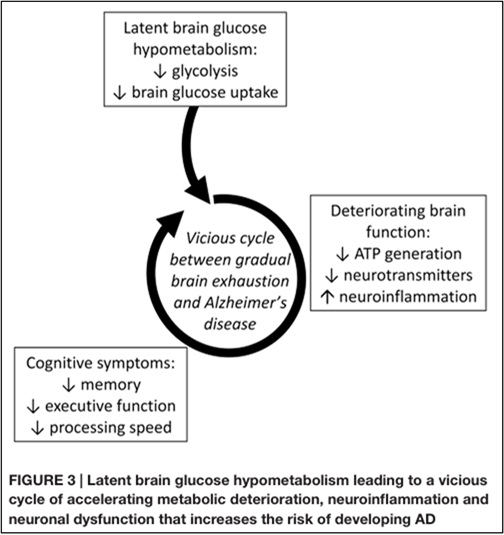
The “brain-energy gap”
Cunnane and group also performed glucose and ketone PET imaging studies in more than 300 young to elderly adults — healthy and with Alzheimer’s and mild cognitive impairment. They learned that even people in their 70s without obvious memory problems have a 7-9% gap in how much energy the brain needs versus how much it receives. This increases to at least 10% in people with mild cognitive performance…And accelerates to at least 20-40% in people with Alzheimer’s.
Safety and toxicity testing
Dr. Veech’s ketone ester was tested extensively in athletes by Dr. Kieran Clarke at Oxford University in England and by many other investigators since then. After toxicity testing in the athletes, the ketone ester was released to the public as a sports drink in 2018, now sold by two companies — KetoneAid and Delta G Ketones.
A larger safety study was performed at Oxford in 24 adults ages aged 18 to 70 who took large doses (25 grams) three times daily for 28 straight days. Out of 2,016 doses, there were no serious adverse events and only 15 mild adverse reactions were reported. These included nausea, mild diarrhea, upset stomach, and headache.
Millions of doses of ketone esters and salts have been taken since these products entered the market in the US in 2016-2018.
Click here for an extensive list of references for lab studies, reviews, and clinical trials of ketones.
How to use ketone esters safely
I strongly recommend consulting your physician before using ketone ester for Alzheimer’s, mild cognitive impairment, any other medical condition or health benefit. I do not recommend use in pregnant or lactating women and children, except in rare cases where someone with a specific condition may benefit, but only under medical supervision.
How much ketone ester?
The cost is often a limiting factor for people who would like to take a ketone ester. Many athletes take 25 to 35 grams before a workout or event, and Steve took 25 grams 3 x daily. But the caregivers of some people with Alzheimer’s and mild cognitive impairment have reported improvements with much smaller amounts of ketone esters. So, 2.5 to 5 grams once to three times daily is a good place to start. If tolerated, consider increasing the ketone ester gradually to 10 or more grams per serving given 2 or 3 times daily.
Taking coconut oil and/or MCT with meals could help sustain higher ketone levels from taking a ketone ester longer. Recent studies found that astrocytes, which nourish and maintain neurons, prefer MCTs as fuel, while neurons prefer ketones. Thus, MCTs and ketones appear to work together to fuel the various types of cells in the brain. Coconut and MCT oils cost much less than ketone esters. So, combining the strategies of using MCTs and ketone esters could potentially lower the overall cost.
Potential Side Effects
If you’re older or have medical issues, such as Alzheimer’s or mild cognitive impairment, check with your doctor before using a ketone ester.
-
High doses (around 40 g or more, or doses taken too close together) can raise ketone levels too much and may cause temporary ketoacidosis, especially if you’re already in deep ketosis. Symptoms like nausea, vomiting, confusion, or trouble breathing need immediate medical attention. (This is different from diabetic ketoacidosis which involves very high blood glucose and lack of insulin.)
-
Lower blood sugar: Some ketone esters can drop blood glucose by 10–20 points. If you use insulin or diabetes medications, monitor closely to avoid lows.
-
Gout: Very high ketone levels can trigger gout in some people. Potassium citrate may help.
-
Dehydration and electrolytes: Ketone esters, ketone salts, and ketogenic diets can have a diuretic effect, so drink plenty of fluids. They can also affect sodium, potassium, and other electrolytes—something to watch if you’re older or have health conditions.
-
Blood pressure changes: Ketone esters may raise or lower blood pressure, so keep an eye on it if you already have hypertension.
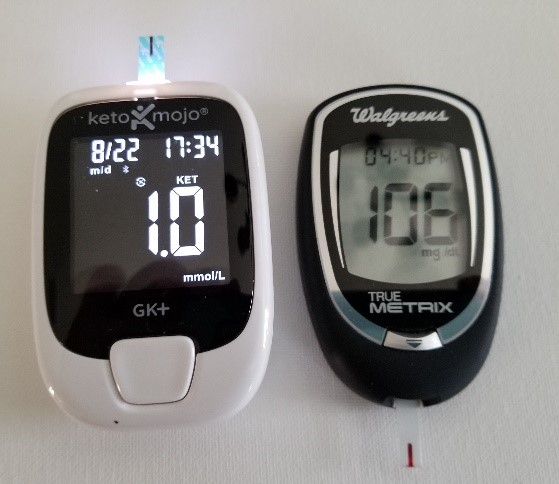
Blood Ketone (Keto Mojo) & Walgreen’s Glucose Monitors
Is it a good idea to measure ketone levels?
Probably not for servings of 10 grams or less of ketone esters taken once or twice daily. However, large doses of 35 to 50 grams could temporarily push levels to 7 mM or higher which is in the ketoacidosis range. This could also happen when taking 25 grams or more if taken close together, such as every 2 to 3 hours, or taking esters along with a strict very-low-carb ketogenic diet — see Potential Side Effects above. Checking levels when trying a new dose could help avoid this issue.
I like to monitor my ketone and blood glucose levels when testing out a new product. The Keto-Mojo device can check both with separate ketone and glucose strips. With practice, it is possible to switch out the strips and get readings for ketones and glucose from the same finger prick. An alternative is to set up a second inexpensive glucose monitor.
Continuous glucose monitors placed on the skin for 2 weeks at a time are already available and continuous ketone monitors should be coming to the market soon.
 Where to find more information on ketone esters
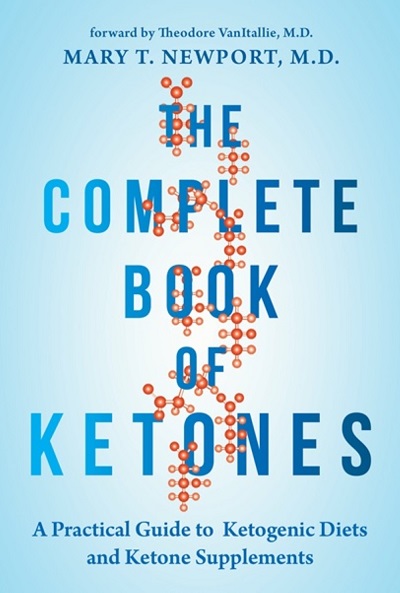
Read my free printable article for a more comprehensive explanation of ketone esters and how to use them for people with Alzheimer’s and mild cognitive impairment. For even more information, check out my book The Complete Book of Ketones: A Practical Guide to Ketogenic Diets and Ketone Supplements. Ketones and ketone esters for Alzheimer’s and mild cognitive impairment are discussed in all of my books!
Where to find ketone esters
The cost and taste vary considerably for the ketone esters currently on the market. The taste of certain ketone esters can affect the willingness of some people to take them. To help you decide, I have tried to address cost and taste in the descriptions of the products. Setting up a recurring shipment can help you save $$ for each of the ketone esters.
Note: Servings sizes on package are meant for endurance athletes. Read “How much ketone ester?” above for suggested serving size. Discuss with your doctor before taking a ketone ester!
Small commissions from Amazon and some other products help support this website.
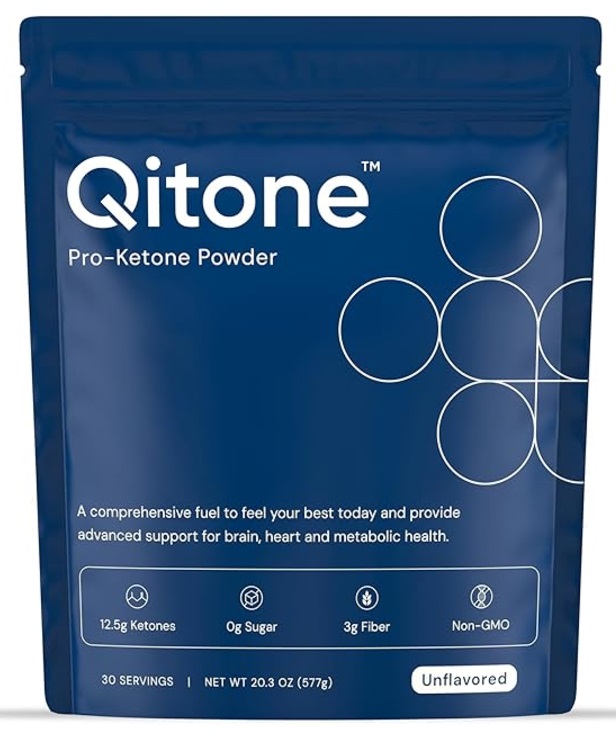
Qitone Pro-Ketone Powder – Lowest price and best taste
The main advantages – lowest cost per gram of ketones and almost no taste.
The taste — virtually flavorless in coffee, tea, water, and other beverages.
The cost — Lowest price among ketones esters at only $0.27 per gram of ketones; the “30-day pack” could supply 75 x 5-gram servings 30-Day Pack – $99.99 ($84.99 with subscription)
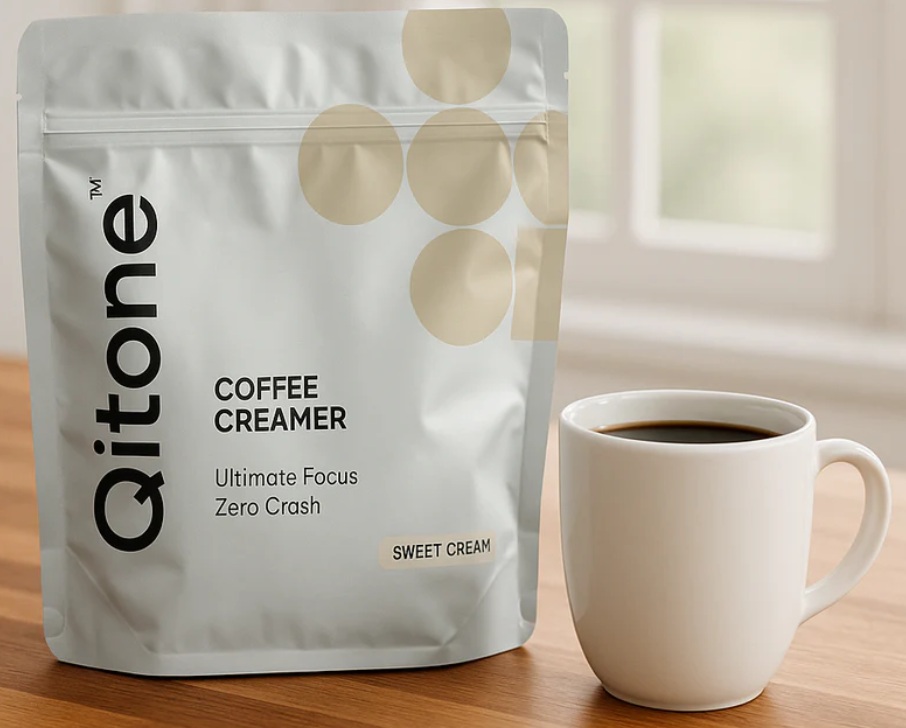 Qitone Creamer
Sweet Cream Flavor — $0.33 per gram of ketones
30 servings x 3-grams ketones (1 tablespoon) – $29.99
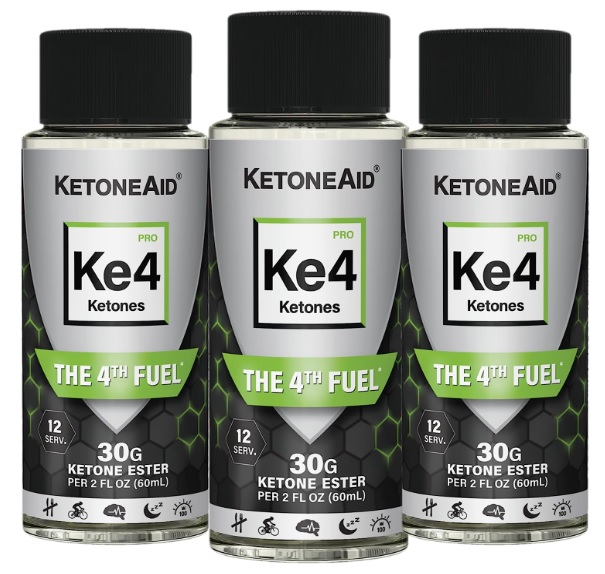
KetoneAid KE4
The ketone ester invented by Dr. Veech that my husband Steve received in the NIH pilot study.
The main advantage – highest peak level per gram of any ketone ester currently on the market
The taste — unusual (think sweetened vinegar) but much improved from earlier versions.
The cost — Moderately high at $0.89 per gram of ketones.
3 Bottle Pack – $79.37 12 Bottle Pack – $304.38 5-gram “Shots” x 12 – $69.95
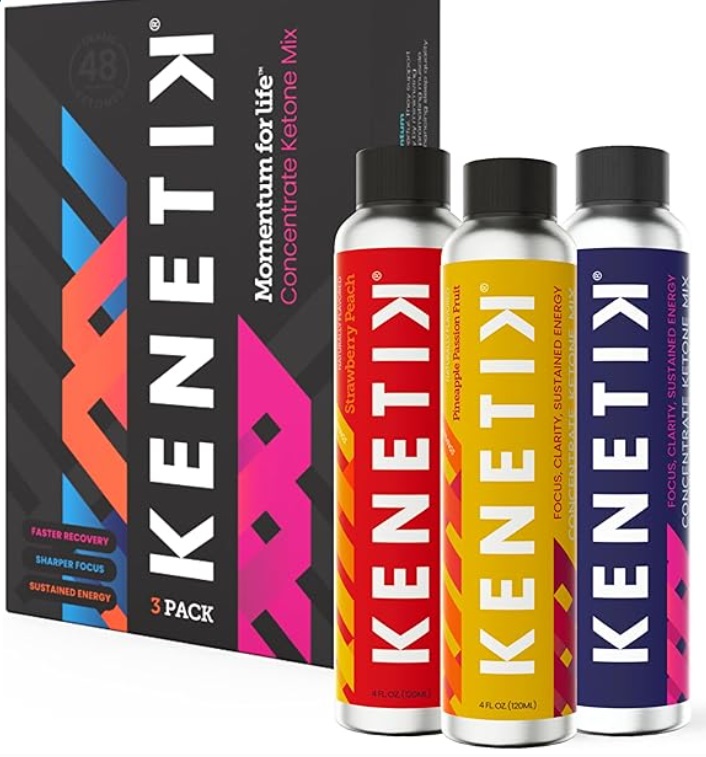 Kenetik Concentrate
The same two components as Dr. Veech’s ketone ester but as a mixture.
The main advantages — Can dilute to taste. Two tablespoons have 12 grams of ketones.
The taste — Tart – strawberry peach, blackberry lemonade, and pineapple passion fruit
The cost — Moderate at $0.41 per gram of ketones
3-Bottle Pack – $59.04 for 12 servings (429.9412 grams ketones per serving)
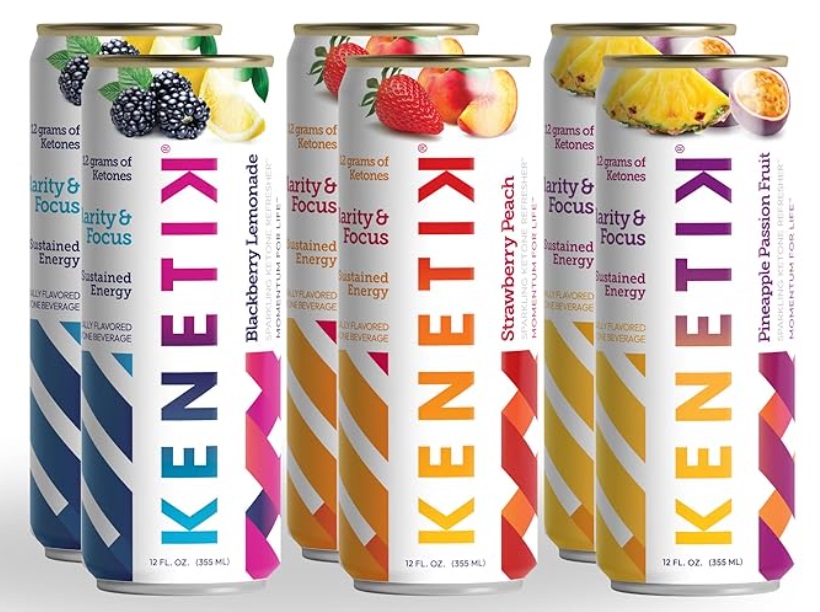 Kenetik Ready-to-Drink Cans
The same two components as Dr. Veech’s ketone ester but as a mixture.
The main advantages — Ready to drink carbonated beverage in a 12-ounce can with 12 grams of ketones
The taste — Refreshing citrusy flavors – strawberry peach, blackberry lemonade, pineapple passion fruit, & watermelon
The cost — Moderate at $0.42 per gram of ketones 6-Pack (12-ounce cans) – $29.94
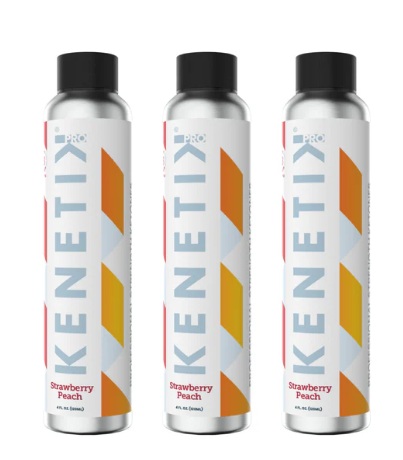
KenetikPro Professional Strength
To be taken only under your doctor’s supervision.
The same two components as Dr. Veech’s ketone ester but as a mixture.
The main advantages — very concentrated, can take undiluted or diluted to taste. One tablespoon has 10 grams of ketones.
The taste — Tart – strawberry peach, blackberry lemonade, and tropical fruit
The cost — High at $0.94 per gram of ketones. 3-Bottle Pack – $149.00 – About 16 servings of 1 tablespoon (10 grams ketones)
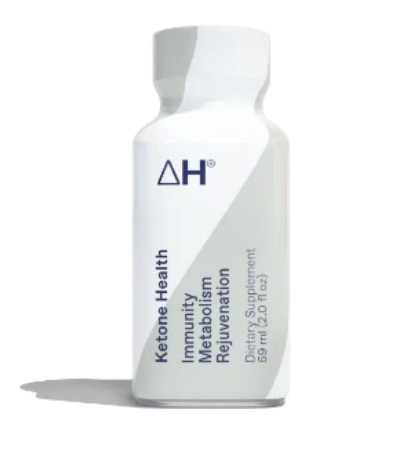 Delta G Ketone Health
Identical to ketone ester developed by Dr. Veech and Dr. Kieran Clarke sold by her company.
The main advantages — Highest peak ketone levels similar to KE4
The taste — Strong concentrated unique flavor
The cost — Highest among ketone esters at $1.90 per gram of ketones (twice the cost of KE4)
3 Bottles (10 grams ketones per bottle) – $57.00
