Hope for Alzheimer’s & Parkinson’s
Mary T. Newport, MD
Physician, author of four books on ketones and brain health, and researcher exploring the potential of ketone therapies for Alzheimer’s disease and other neurological disorders.

Mary T. Newport, MD
A Welcome Message from Dr. Mary Newport (Video)
When my husband, Steve, developed early-onset Alzheimer’s disease, we experienced firsthand the heartbreak and helplessness that so many families face. In 2008, after discovering that coconut oil could provide an alternative source of energy for his brain, I began giving it to him. Within days, we saw improvements that we had only dreamed were possible.
I created this website to share Steve’s story, what I have learned about ketones and brain health, and the growing body of scientific research exploring their potential benefits.
My hope is that you will find useful information, practical guidance, and encouragement here, whether you are caring for someone with Alzheimer’s or Parkinson’s disease, or simply interested in keeping your brain healthy as you age.
Where should you begin? My four books explore Steve’s remarkable story, the science of ketones, and practical ways to incorporate coconut oil, MCT oil, and other approaches to brain health into everyday life.
Coconut Oil, Ketones, & Brain Health
Our brains need a constant supply of energy to function properly. Glucose is normally the brain’s main fuel, but in Alzheimer’s disease, Parkinson’s disease, and even during normal aging, some areas of the brain become less efficient at using glucose.
Fortunately, the brain can also use ketones, an alternative fuel that provides energy even when glucose metabolism is impaired. Research suggests that ketones may offer additional benefits beyond energy production, including reducing inflammation and supporting healthy brain function.
Coconut oil and MCT oil are convenient and relatively inexpensive ways to increase ketone production. Medium-chain triglycerides (MCTs) are fats that the body can convert into ketones. MCT oil, which is commonly derived from coconut oil, generally raises blood ketone levels more than coconut oil alone.
Ketone esters and ketone salts are another way to increase blood ketone levels. These supplements provide ketones directly and can raise blood ketones more rapidly than coconut oil or MCT oil, although they are generally more expensive.
Learn More About Ketone Esters | Learn More About Ketone Salts
Clinical Studies Show Promising Cognitive Benefits
Older FDA-approved Alzheimer’s medications, such as donepezil (Aricept), rivastigmine (Exelon), galantamine (Razadyne), and memantine (Namenda), may temporarily improve or stabilize cognitive symptoms in some people, but they do not stop or reverse the underlying disease.
Newer amyloid-lowering drugs, including lecanemab (Leqembi) and donanemab (Kisunla), have demonstrated modest slowing of cognitive decline in people with early Alzheimer’s disease. However, these drugs carry significant risks, including brain swelling or fluid accumulation (ARIA-E) and small areas of bleeding or iron deposits in the brain (ARIA-H). In clinical trials using current dosing regimens, approximately 21% of patients receiving lecanemab and 29% receiving donanemab developed one or both of these abnormalities on MRI. Most cases caused no symptoms, but serious and occasionally fatal complications have occurred.
Meanwhile, a growing number of clinical studies have investigated MCT oil and coconut oil as potential nutritional approaches to improving brain energy metabolism.
At least 20 studies involving MCT oil, including three using coconut oil, have reported improvements in memory, cognition, or other symptoms in some participants, including older adults and people with mild cognitive impairment or Alzheimer’s disease.
Although results vary among studies and additional large clinical trials are needed, these findings suggest that ketone-producing oils deserve further investigation as a practical approach to supporting brain function.
View the Clinical Studies of Coconut Oil and MCT Oil | Download the Table of Clinical Studies (PDF)
Hundreds Have Reported Improvements with Coconut Oil and MCT Oil
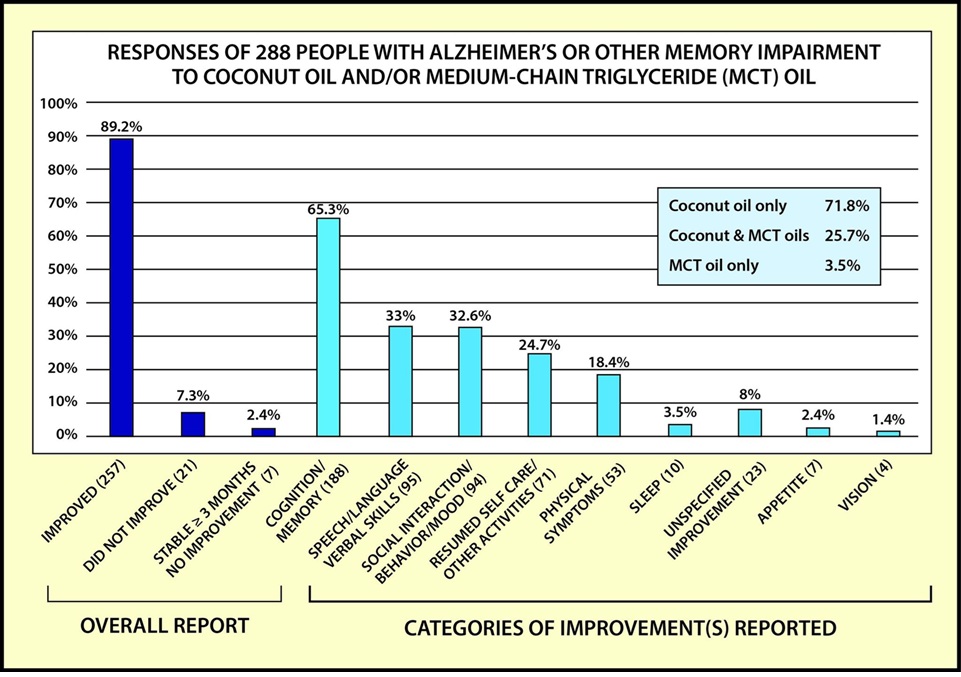
Reported improvements among 288 people using coconut oil or MCT oil. Newport, 2024.
Since 2008, I have received hundreds of emails from people and caregivers describing their experiences with coconut oil, MCT oil, and ketone supplements for Alzheimer’s, Parkinson’s, and other memory or neurological conditions. In 2023, I presented an analysis of these reports at the Alzheimer’s Association International Conference in Amsterdam.
In 2024, I published a more detailed analysis of 288 individual and caregiver reports, in which nearly 90% described improvements after using coconut oil or MCT oil.
Reported improvements included memory and cognition, speech and conversation, social interaction, mood, behavior, and physical abilities. Some individuals were able to resume daily activities, personal care, and hobbies they had previously lost the ability to perform.
These reports are encouraging, although they are personal observations rather than controlled clinical trial results. Together with the emerging clinical research, they provide additional reasons to investigate ketone-based nutritional approaches for brain health.
Read My Published Analysis of 288 Reports
Talk to Your Doctor
If you or someone you love is living with Alzheimer’s disease, Parkinson’s disease, or another neurological condition, I encourage you to discuss nutritional approaches that support brain energy metabolism with your healthcare professional.
Coconut oil, MCT oil, ketogenic diets, and ketone supplements may offer benefits, but they should be introduced thoughtfully, especially for people taking medications or managing other medical conditions. These approaches are not substitutes for prescribed treatments.
My hope is that the information and research shared on this website will help you make informed decisions and explore additional ways to support brain health.
All the Best to You and Your Loved Ones,
Dr. Mary Newport
What Coconut Oil and Ketones Did for My Husband Steve with Alzheimer’s
 When my husband, Steve, was approaching the later stages of early-onset Alzheimer’s disease, between stages 5 and 6 on the seven-stage scale, I was desperately searching for something that might help. Then I learned that coconut oil contains medium-chain fatty acids that the body can convert into ketones, an alternative source of energy for the brain.
After Steve began taking coconut oil, and later MCT oil, we saw changes within days that neither of us had dreamed were possible.
“It was like a light switch came on in my head,” Steve told me the day he started coconut oil.
 Steve became more alert and talkative, his sense of humor returned, and the blankness in his face disappeared. He could finish sentences again, recognize relatives, and the tremors in his hands and face resolved.
Over the following weeks and months, he regained abilities we thought were lost. He could mow the lawn, complete projects around the house, and even volunteer at the hospital where I worked. His walking improved, and he could tie his shoes again. After three months, his visual disturbance cleared up, allowing him to read again. By nine months, he could remember what he had read hours earlier.
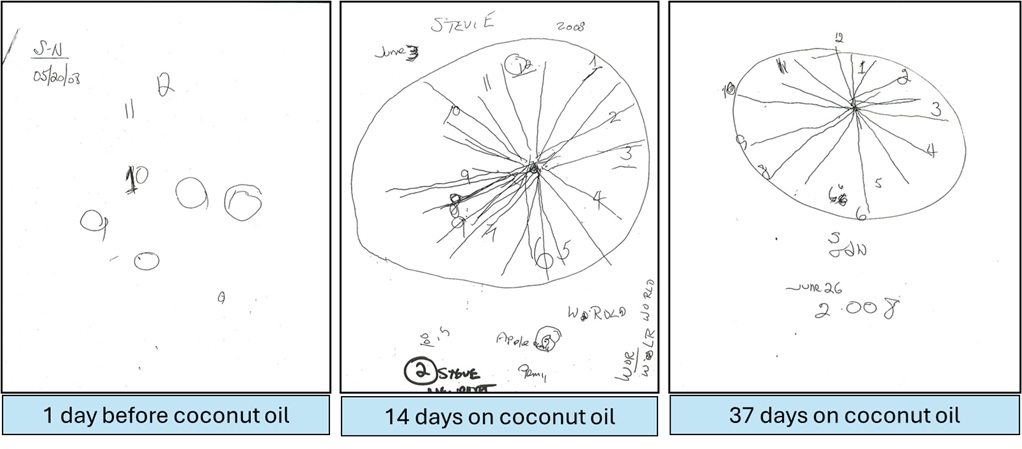
Steve’s clock drawings show some of the changes we witnessed. As part of an evaluation for a clinical trial, he drew the first clock the day before starting coconut oil. His drawing improved remarkably after just 14 days and was even more organized after 37 days.
Watch Mary and Steve Newport on The 700 Club (2012)
In this five-minute television report, Steve and I share our experience with coconut oil following his diagnosis of early-onset Alzheimer’s disease.
A Ketone Ester Pilot Study
Two years after Steve began taking coconut oil, he experienced a serious setback in 2010. Dr. Richard L. Veech of the National Institutes of Health (NIH) invited Steve to become the first person to receive his experimental ketone ester in a pilot study.
Within 24 hours of starting the ketone ester, Steve was once again able to shower, shave, and dress himself without my assistance. Over the following weeks, he resumed helping with yardwork and household projects.
Steve told me he felt “good,” had “more energy,” was “happier,” and found it “easier to do things.” I could clearly see these improvements myself.
Coconut oil, MCT oil, and Dr. Veech’s ketone ester gave us nearly four years of better quality of life than Steve had experienced during the year before he started coconut oil.
Published in Alzheimer’s & Dementia, this report describes Steve’s response to the ketone ester developed by Dr. Richard Veech at the NIH, including changes in cognition, mood, daily functioning, and self-care during 20 months of treatment.
Remembering Steve

Steve and Mary Newport, December 2008, seven months after starting coconut oil.
Steve passed away on January 2, 2016, at just 65 years old. He had chosen to donate his brain to the Florida Brain Bank to help advance research into Alzheimer’s disease and other dementias.
The examination confirmed that Steve had both Alzheimer’s disease and Lewy body disease. Having these answers brought us a sense of closure, and I encourage other families to consider brain donation as a way to contribute to future research.
What Do We Have to Lose?
The day before Steve started coconut oil, we left his first screening for an Alzheimer’s clinical trial feeling deeply disappointed. His disease had progressed, and I was running out of options that might help him. As we stopped to buy coconut oil on the way home, I remember thinking, “What do we have to lose?”
I could never have imagined how much those simple words would come to mean to us. Within days, Steve began experiencing improvements that neither of us had dreamed were possible. What began as a desperate search for something that might help became a journey that changed both of our lives.
Although we ultimately lost Steve to Alzheimer’s, the improvements we experienced gave us nearly four more precious years together. His story continues to inspire my work and my determination to help other families facing these devastating diseases.
I believe that continued research into ketones and brain energy metabolism offers a promising avenue for improving the lives of people affected by Alzheimer’s and related neurological disorders.
Read My Original 2008 Article: What If There Was a Cure for Alzheimer’s Disease? (English) | Spanish Translation
Where to Go Next
New to ketones and brain health? Start with an overview of how ketones may help support brain energy and cognition.
Interested in an easy, food-based approach? Learn about coconut oil and MCT oil, including practical information and clinical research.
Curious about ketone supplements? Explore ketone salts and their effects on blood ketone levels.
Want to learn about ketone esters? Discover how they work, what research has been conducted, and the available products.
Interested in ketogenic and low-carb diets? Explore dietary approaches to increasing ketone production naturally.
Dr. Mary Newport’s Books on Ketones, Alzheimer’s & Brain Health
As an Amazon Associate, I earn from qualifying purchases. These commissions help support this website at no additional cost to you.
Steve’s story, ketone science, and practical guidance.
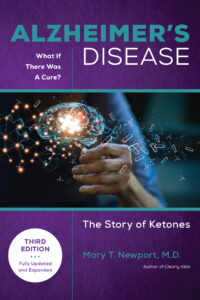
Alzheimer’s Disease: What If There Was a Cure? The Story of Ketones (3rd Edition)
Mary T. Newport, MD | Turner Publishing, 2023
This updated edition tells the remarkable story of my husband Steve’s experience with coconut oil, MCT oil, and ketone ester after developing early-onset Alzheimer’s disease. It also explores the growing body of research on ketones as an alternative source of brain energy and their potential role in Alzheimer’s, Parkinson’s, and other neurological conditions.
Healthy brain aging through food, ketones, and lifestyle.
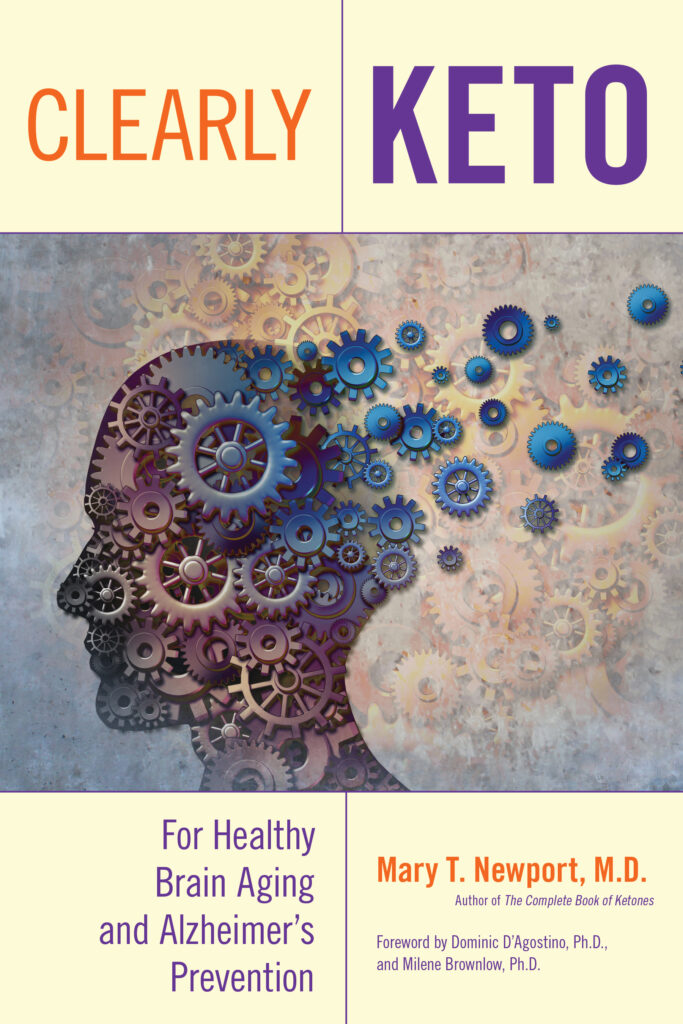
Clearly Keto for Healthy Brain Aging and Alzheimer’s Prevention
Mary T. Newport, MD | Turner Publishing, 2022
What can you do today to protect your brain as you age? Clearly Keto explores how a whole-food, Mediterranean-style low-carb diet, coconut and MCT oils, ketones, and healthy lifestyle choices may support memory and cognitive health. It offers practical guidance on blood sugar control, exercise, sleep, and other approaches to reducing dementia risk.
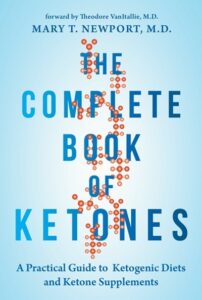
Ketone research, ketogenic diets, and supplements.
The Complete Book of Ketones: A Practical Guide to Ketogenic Diets and Ketone Supplements
Mary T. Newport, MD | Turner Publishing, 2019
A comprehensive guide to the science and practical applications of ketones. Learn how ketogenic diets, coconut oil, MCT oil, ketone esters, and ketone salts work, along with their potential uses for brain health and other conditions. Featuring insights from leading researchers, clinicians, and people using ketogenic therapies, this book provides practical guidance for choosing, using, and monitoring these approaches.
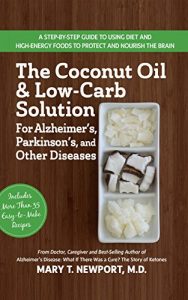
Coconut oil, MCT oil, and practical low-carb nutrition.
The Coconut Oil and Low-Carb Solution for Alzheimer’s, Parkinson’s, and Other Diseases
Mary T. Newport, MD | Turner Publishing, 2015
Discover practical ways to incorporate coconut oil, MCT oil, and a moderately low-carbohydrate diet into everyday life. This accessible guide explains how these dietary changes can increase ketone production and may support brain energy metabolism. Includes recipes, meal ideas, and personal experiences from people affected by Alzheimer’s, Parkinson’s, and other conditions.
